Saturday, 1 December 2012

Scott and Karen trip to Rottnest Island, Dec 1

Rottnest Island lies 19 km offshore from Fremantle. It got its name from the Dutch for "rat's nest", so named because early Europeans thought it was infested with rats. The rats were in fact a local marsupial called the quokka which can be found all over the island.  We boarded a ferry in downtown Perth, cruised down the Swan River and out to the island
Bell Tower in downtown Perth


Downtown Perth seen from the back of ferry


We took a tour on a bus while on the island. The bus did not have an emergency exit per se, but rather a little hammer with which to break a window, perhaps allowing one to crawl over shards of broken glass?


 There is some incredible scenery on the island. All kinds of little bays and coves abound


Wadjemup Lighthouse lies very near the centre of the island. It gets its name from the Aboriginal name for Rottnest Island, Wadjemup, which means "place of the ancestors".


 There are several small salt lakes on the island. This is one of many. Wadjemup lighthouse is visible in the background.


There are also numerous shipwrecks surrounding the island. Over the centuries of European colonization of Australia, many ships were wrecked on the reefs of the island.


The Quokka. From which the island gets its name. Sort of. Early settlers though this marsupial, belonging to the Family Macropodidae (which also includes kangaroos and wallabies), was a rat.  Quokka is the Aboriginal word for this animal. They are for the most part, nocturnal, but many can still be found up and about during daylight hours.  Since they have no natural enemies, and also since they see people all the time, they don't run away when you get close and try to take photos.


There is also an incredible variety of birds on the island.  The bus tour guide operator said that over 180 species of bird call the island home, with numerous other transients and migratory birds making appearances.  
Osprey on nest

Osprey in flight

Rainbow bee-eater

Australian crow

Black-winged stilt

Red-necked avocet
 

Rebecca's Saturday, Dec. 1

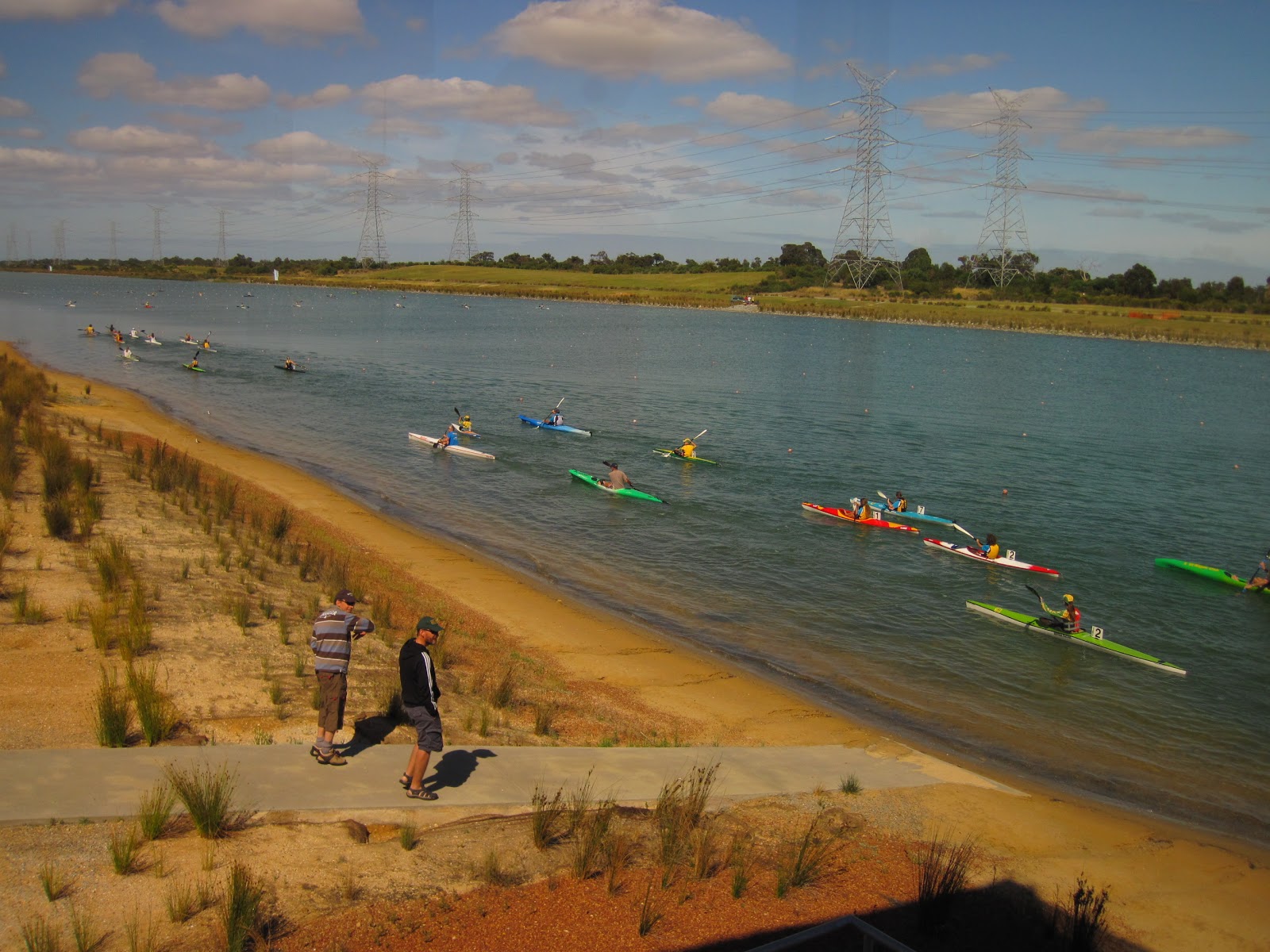
I had never witnessed a kayak regatta and had the opportunity to, not only go to one, but experience it from the tower! 

Background - When my son was involved in go-kart racing I had worked in the tower for the national go-kart races held in Calgary and was interested to see the organization of the kayak racing. I also do recreational canoeing and kayaking so of course, I was not going to pass this up even if it meant missing going to Rottnest Island.

 The start tower at Champion Lakes and the behind scenes running of a regatta.

The end of a race. They have backups of determining the finishing order; people who watched and spotted, a timer beeper system and a video camera.
 A group of racers receiving their
pre-race instructions.
A view from the tower.


The races run were 200m, 500m and 1000m.  I walked around the complete 2000m course and viewed it from the end. A fantastic facility.  At the far end was a start tower and staging area, but as on this day they were not having that distance it wasn't used.


Anyway, I learnt and saw many more details of the regatta, but I am running out of "umph" and you are maybe are not as interested in such things.

The afternoon was spent doing a road trip loop south and east and back, learning about all sorts of trees and flowers.  The colors of "green" are incredible and there are so countless different types of eucalyptus or "gum" trees.  It seems that even when you crush the leaves from trees that you think are the same, you get a different smell.


Do you know what this is?
It is rather interesting, don't you think!


Perth RTG Conference Day 3

Teresa Slaven-Blair - Evolution and Types of Black Holes

What is a black hole?  How would we make a black hole? There are three types of black holes; two have been found and one is still hypothetical - X-binary, AGN and Kugelblitz
Demonstration of energy transfer
 
Scott helped illustrate the energy transfer involved in Supernova formation.

Tips and Tricks

At least 20 tips and tricks were shared and there were many "ah, good idea" moments followed by hurried scribbling of them down so as to be able to share them back home.

Biological Laboratory Techniques - Joy Unno, Glenda Brown

The session started with a information on resources, safety and biohazards, micro-organisms, keeping animals and plants, preservation of biological materials, dissections, microscopes and enzymes.

It was interesting to learn that there is a separate human biology course in addition to a biology one.  Most dissections are done on fresh tissue rather than preserved and so no formalin solution or formalin treated tissue to dispose of.  There is no human blowing up of pluck, rather basketball pumps are used.  If animals are to be kept, a license is required and must be displayed in a public place and by cages. Permits are required for translocation of fish and for collecting of wild plants.  Only commercially obtained tissue (ie. inspected) may be used for dissection.

We had 6 demos and were able to try our hand at 7 activities.


Field studies equipment
Making a square meter outline


Making nutrient agar
Use oven bags for sterilizing petri dish cultures for disposal
Pressure cooked culture plates
Photosynthesis experiment


Observing yeast budding
End of conference dinner with RTG technicians, conference organizers and attendees


Thursday, 29 November 2012

Tour of Atwell College
     - a Secondary School in the south Perth suburb of Atwell       
Atwell College

Our host Anne-Marie gave us a tour of her workplace.  Atwell College is a Grade 7 to 12 school that opened in 2008 and has just added a new Science teaching area.  We were welcomed by the Principal of the school before touring the Science area, where we marveled at the modern, clean & organized spaces.


Atwell College campus


Entrance to lab classroom
Lab classroom - S, R & Anne-Marie

Preparation area

Vertical storage - Prep area


Sc Tech work space
Chemical Store


Perth RTG Conference Day 2

Professor Lyn Beasley AO, Chief Scientist of Western Australia gave the opening address.  She spoke of the WA skill shortage and the priority occupation list, which were largely science, math and engineering related. 

Science is learned by doing when carried out safely and ethically and when it works. Science technicians are instrumental in achieving this.  She talked about a number of school science student involvements ... science in action... climate, biodiversity, restoration, agriculture (fungus in barley).  Currently there is a major radio telescope project to scan the sky using 3 ranges of wavelengths to map a square kilometre array (SKA) of the sky.  Developing these technologies will have spin offs into other technologies, eg. SAT navigation.

Lyn's personal pet projects are:
1. microscopes in schools program
2. increasing school laboratory technician  support
http://minister.innovation.gov.au/chrisevans/MediaReleases/Pages/InvestingInScienceAndMathsForASmarterFuture.aspx

Students ensure the future and education is key in changing the "culture" of society.

Scott, Karen and Rebecca presented our Calgary contingent powerpoint, which was well received. We started with a tongue in cheek you tube video:

 We then went on a field trip: Rocky Relationships, an excusion to Peppermint Grove and Fremantle.

Rocky Relationships Fieldtrip
Analyzing the Evidence


Fremantle Architecture

Rhizolith


Erosion

Rebecca Busted

We were touring through Freemantle at the old roundhouse prison and Rebecca went and got herself into trouble.  She went and disobeyed a police officer.   There is only one suitable punishment for such an offence.


We wanted to pelt her with rotting produce to humiliate her further, but the authorities decided that the stocks were punishment enough in themselves.


Wednesday, 28 November 2012

Hazchem Refresher Course 
by RTG at Northlake Sr. College, Perth

Today we attended the second day of a required Hazchem Refresher course... new science techmicians in Western Australia are required to take a hazardous chemicals course and refresh it every 5 years.

There are 8 regional technicians in Western Australia that provide training and assistance to public school technicians.  They hold regional workshops and provide courses for technicians.

The day started with a review of the various legislative and regulatory bodies that are relevant to science technicians: Department of Mines and Petroleum Dangerous Goods Regulations on the Storage and Transport of DangerousGoods, Department of Commerce - Worksafe Occupational Health and Safety Act (1984) and Regulations (l996), Department of Health Guide to Labelling of Drugs and Poisons (l995) and Department of Education Occupational Safety and Health Policy Science Laboratory Manual.

Hazards and Chemical Properties were reviewed and how/where to find information on MSDS. Mercury will no longer be obtainable, but current supply usable until depleted.  Uranyl nitrate, bromine and acetic anhydride are now banned for school use in WA.

General Laboratory Safety Practices - examples of things to do and not to do.

There was a review of Dangerous Goods Classification and Chemical Storage Layout,,, chemical storage follows a vertical segregation organization, labelling of containers according to Regional Technician Group's (RTG's) Quick Reference Guide (QRG) and "bunding" of chemicals (solution containers of specified concentrations and volumes must be kept in a container that will hold that volume of solution should the primary container leak, spill, be broken).

Risk Assessments are required by law and for Western Australia schools this is considered having been performed by having a copy of the RTG chemical hazard information sheets for the chemicals used in the particular lab.

The last section of the day was on Waste Disposal (labelling, storage, disposal) and Spill Clean Up (types of spills, spill kit contents, spill clean up).

The topics had group or individual activities, such that both content and practical experience was delivered and gained.

There were some slight differences (tweakings), but for the most part, we found the approaches to chemical hazards to be similar with those used in Alberta schools.

By way of the RTG's the public WA science technicians receive a consistent training, overseeing and guidance.  We understand that there are approximately 200 public school science technicians and another approximately 150 independent school technicians that have their own organization.